

“In vain, great-hearted Kublai, shall I attempt to describe Zaira, city of high bastions. I could tell you how many steps make up the streets rising like stairways, and the degree of the arcades’ curves, and what kind of zinc scales cover the roofs; but I already know this would be the same as telling you nothing. The city does not consist of this, but of relationships between the measurements of its space and the events of its past”. Italo Calvino (Invisible Cities, Einaudi 1972) brilliantly describes the essence of a city, expressed through the relationship between its spaces and the stories it has seen, injust a handful of lines. The fourth issue of humus® investigates this relationship.
The fabric of cities – in which 45% of the planet’s 8.2 billion people live (only 20% in 1950) – is built at the crossroads of these human and architectural-spatial dimensions. These figures are reported by the UN World Urbanization Prospects 2025, and forecasts also indicate that two thirds of the world’s demographic growth up to 2050 will be in cities. Like much of the present, the future therefore depends on how far we are able to understand and govern this relationship.
The starting point is our ability to identify the sense and soul of a city. These two elements cannot be found (at least, not alone) in the defining data and graphs but rather in the histories they embody, those of the past and those that create the present, day by day. Stories of people and dreams, needs and plans, that build up, layer after layer – if the city is virtuous – in line with the genius loci, the spirit of the place. Being able to understand this is not only a literary divertissement, but a method for identifying the profound dynamics of cities, capturing that most useful ‘invisible’ aspect that Calvino used to define cities in his book: it is the method of the flâneur – those who venture into the city on foot and get lost there – that the urban sociologist Giampaolo Nuvolati describes for humus® in his short essay The identity of the city.
The many current investigations on the relationship between city and memory frame the matter from unexpected viewpoints: like Ricky Burdett, urbanist and curator of the exhibition Rome in the World at the MAXXI in Rome, who explained to humus® how the exhibition offers a faithful portrait of the Eternal City, with its contemporaneity and history, its development and imagination. And then the viewpoint of GXN, the Danish research centre that investigates behaviour, materials and urban policies: Mattia Di Carlo, Circular Design Specialist at GXN, describes the pathways and experiments in progress on the sustainable reuse of urban buildings, helping to transform cities into large circular infrastructures.
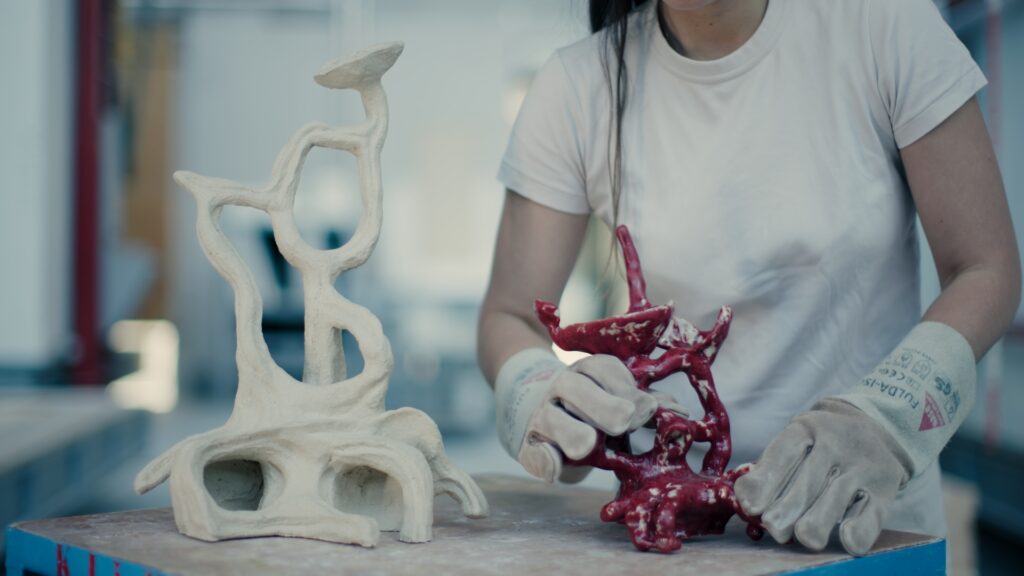
Art also looks at urban memories as a source where treasures can be found: this is told by Bouke de Vries, who became an artist after specialising in ceramic restoration and who creates his works using only broken household ceramics. This issue also offers other excellent voices, describing investigations and experiments on the memory of cities, like that of the sound artist Stuart Fowkes, who has been collecting the sounds of the cities for ten years, or that of the curator Antonio Oriente, who through art brought the Herakleia archaeological site in Basilicata (Italy) back to life, offering visitors the living perception of a very distant past.
As Italo Calvino suggests in Invisible Cities, the way we live the city depends on our viewpoint and our ability to imagine things differently. Some of these are proposed in this issue of humus®, hoping that they can offer food for thought and ideas for cities that are not only efficient but more aware – and happier.